
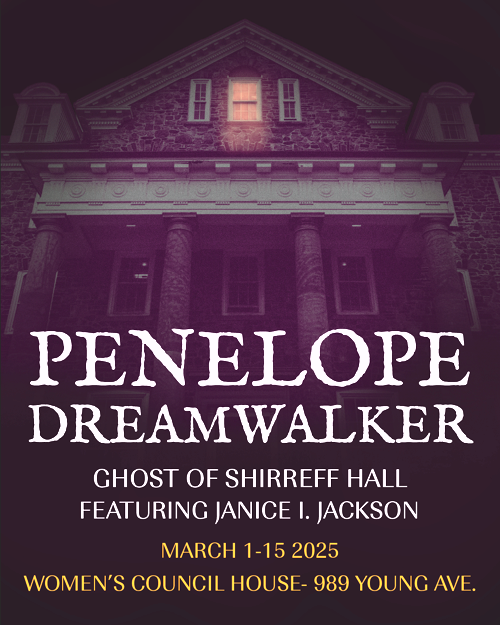
 One of Dalhousie University’s oldest legends is viewed through fresh, compassionate and contemporary lenses in new works opening next week; one is substantially queer and we have an inside view of it by one of the creators, below.
Penelope Dreamwalker: Ghost of Shirreff Hall is an intimate evening of three Canadian mini operas about the most persistent legend of Dalhousie University residence, Shirreff Hall: that of Penelope The Ghost. She is said to be a resident who never left — a young woman, scorned and heartbroken, forever cursed to creep the building’s corridors.
From chambermaid of the 1920s whose fate was shaped by stigma, to present‑day encounters with Shirreff Hall students navigating evolving understandings of gender and identity, Penelope Dreamwalker invites audiences to consider how past injustices continue to echo today. These operas offer space for remembrance, empathy, and renewed attention to voices that have too often been overlooked.
The production reimagines Penelope’s story as a reflection on the pressures, expectations, and silences historically placed on women. Themes of lost love, unwed pregnancy, and limited choices reveal how societal judgment has shaped, and often constrained, women’s lives across generations.
The program brings together works by Sophie Dupuis & Monica Pearce, James Rolfe & Luke Hathaway, and Janice Isabel Jackson and includes two world premieres. It is directed by Emily Jewer, with costumes by Arianne Pollet Brannen and audio engineering by Dylan Hay. The evening is supported by Arts Nova Scotia.
Penelope Dreamwalker: Ghost of Shirreff Hall will be performed March 1–4, 6–8, 13–15, 2026 at 7:30 p.m. at the Women’s Council House, Halifax. There are a maximum of 25 seats per show. Adults $30 • Students/Seniors $25. Some of the works briefly touch on suicidal ideation and relationship‑based harm, which may be distressing. Tickets here.
Editor: the Women's Council House could itself be considered somewhat a queer space; check out the Halifax Rainbow Encyclopedia page about it.
Inside Do You Hear Me?
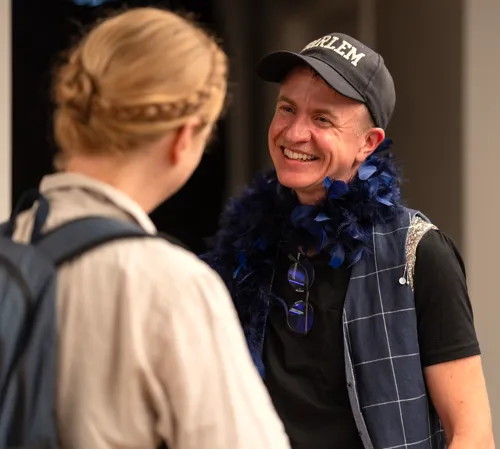
The third of the operas is Do You Hear Me? with words by Luke Hathaway. Luke writes:
About three years ago, an old friend and colleague of mine, Toronto-based composer James Rolfe, asked me to write a libretto for him: text for a mini-opera about the personage of Penelope, the legendary ghost of Dalhousie University’s Shirreff Hall residence.
Penelope has been experienced by generations of students. One of my mentors who dated a Sherriff Hall resident in the 1970s says he remembers stories of the spectral presence from that time. The Dal student newspaper perennially revives and reinvestigates the story -- for instance, here.
I'd like to include a shout-out to generous Dal and King’s U students / recent alums who helped me with my research.
I was interested in the longevity of this ghost, and also in the ways in which she is typically gendered: read as female and, furthermore, as pregnant, by her haunt-ees. It made me remember how, when I was myself a student (gendered female, on my 1990s college campus), my AFAB (Assigned female at birth) contemporaries and I were haunted by the ghost of pregnancy: like, getting pregnant by accident was the worst thing that could happen to you, if you were an undergrad. Pregnancy was the end of your life. (Never mind the fact that the one residence-mate of mine who actually did become pregnant, came back to cross the stage ahead of me at graduation, victorious, having earned honours with distinction.)
I don’t know how she felt, but — well, I know what it’s like to have a traumatic affair.
Pregnancy was the end of Penelope’s life; the legends say that she killed herself after finding herself with child, in the wake of a traumatic affair.
Yikes!
I don’t know how she felt, but — well, I know what it’s like to have a traumatic affair. And, I know what it’s like to have conflicted feelings about pregnancy. Not many of the men I know have had the experience of being pregnant; I am a man, and I have had that experience, though I bore both my kids before I ‘transitioned’, socially/legally/medically. The ghost of those pregnancies haunts my masculinity, in ways that are both campy and wild.
I know some things about despair as well; in the difficult years leading up to my transition, there was a lot of it. At that time, I felt particularly close to an ancestor of mine, a great grandmother who took her own life when she was in her early 40s. When I decided not to die, but to transform myself, I felt that she was with me.

Ghosts, then, can intervene in lifesaving ways. This became the seed of my Penelope story, the mini-libretto I eventually wrote for James. The opera, Do You Hear Me?, is a story about queerness and transformation and the ways we haunt each other and our ancestors/descendants. It is about gender, ghosts and pregnancy. About femininity and masculinity, and the places of common ground that might be found between them. It is about a 20th century femme ghost who encounters a 21st century masc pregnant guy, and intervenes — perhaps to save his life.
The music that James wrote for Penelope to sing evokes the spectrum of decades Penelope has lived through (or... not-lived through): the 20s, the 30s, the 40s, the 50s; whole vast musical eras unfolding even as the discourses of gender and queerness unfold, changing the world while Penelope stays the same. Or does she?
Our conversations about gender and generational languages of queerness formed another layer of inspiration.
Penelope’s story will be brought to life in the world premiere of this opera by soprano Janice Jackson, of Vocalypse Productions, and by soprano/violinist Sarah Frank. Janice, who commissioned the opera, was an active co-creator in the shaping of the story. Our conversations about gender and generational languages of queerness formed another layer of inspiration.
I had originally imagined the opera’s principal character as genderqueer but Janice was uncomfortable playing the non-binary character, for fear of appropriating a voice too far beyond the realm of her lived experience. Together, and with James — who brings his own gender experiences, his own hauntings — we devised this story of intergenerational, and intergender-ational encounter. The opera is titled Do You Hear Me?
Penelope, like all of us, just wants to be heard; she just wants to be seen.
Luke Hathaway (he/him) is a professor of creative writing and English literature at Saint Mary’s University. He is the author of four books of poems and co-creator of numerous works for the stage, including most recently Eurydice Fragments (re:naissance opera, 2024) and Mme Caeneus’s Canteen (ANIMA, 2026).